


From Stream to Socket: How the HNP Mini Turbine Makes Clean Energy Accessible Anywhere
- HNP Power

- Apr 16, 2025
- 4 min read

The global push for renewable energy often focuses on large-scale wind farms, solar grids, and hydroelectric dams. But for remote and off-grid communities, the challenge is not about scale — it’s about access. These areas need power systems that are small, efficient, self-sufficient, and able to work without traditional infrastructure. Enter the HNP Power Mini Hydraulic Turbine: a compact and intelligent hydropower solution that harnesses the energy of rivers and creeks to provide clean, quiet, and reliable electricity in the most hard-to-reach places.
The Challenge of Powering Remote Communities
Canada’s geography is both a marvel and a logistical hurdle. Its sprawling rural and northern regions are home to thousands of communities disconnected from the main power grid. Many of these rely on diesel generators, which come with a long list of drawbacks — high fuel costs, unpredictable deliveries, environmental degradation, and toxic emissions.
Each year, hundreds of millions are spent shipping diesel fuel to isolated settlements using barges, ice roads, or small aircraft. These deliveries are not only costly, but also weather-dependent, often leading to delays or cancellations that leave entire communities without energy for heat, light, or communication. In places where winter lasts more than half the year, this is more than inconvenient — it’s dangerous.
The Concept Behind the HNP Mini Turbine
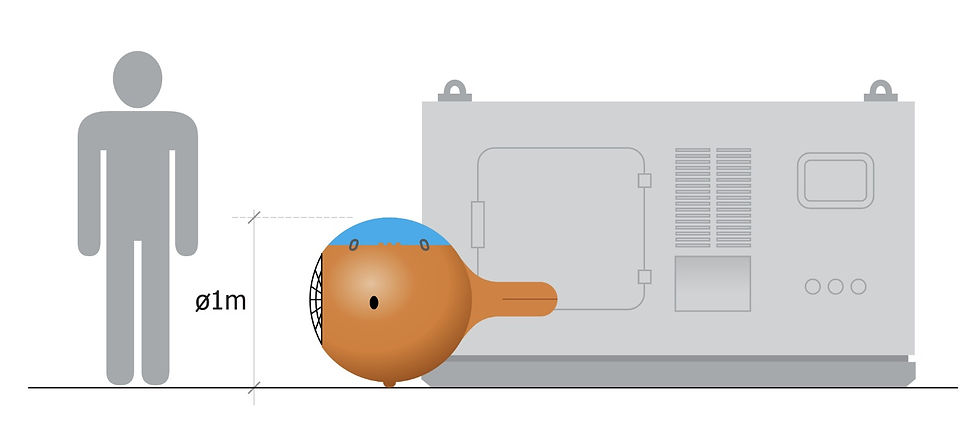
HNP Power developed a system that turns any moving water source — even small creeks or slow-flowing rivers — into a steady, renewable source of electricity. The core of the system is a compact turbine unit powered by a hydraulic ram pump and a radial-axial turbine design, which together generate electricity from flowing water's kinetic force.
The turbine is built to be completely self-sufficient. It doesn’t need a dam, doesn’t block the river, and doesn't require deep installation. It sits within the current or is connected via a small pipe system that channels water from nearby sources. As water flows through or over it, the turbine blades rotate, converting its movement into usable power. And because of its low flow requirement, even streams with minimal drops or shallow gradients can generate enough electricity to power a household.
Smart Deployment, Minimal Effort
One of the standout features of the HNP turbine is its automatic positioning system. With two anchor points and an onboard set of sensors, the system calibrates itself in the water, adjusting the cable lengths until it finds the ideal angle for maximum efficiency.
This means communities don’t need engineers or technicians to deploy the turbine. It can be installed by a small team in under a day — no concrete foundations, no damming, and no disruption to local aquatic ecosystems. If water levels drop or rise due to seasonal shifts, the system adjusts accordingly, maintaining power output with no manual intervention.
Inside the Turbine: Technology in Motion
At its heart, the turbine features a generator with load regulation, automatic water level sensors, and an adaptive nozzle system. As water enters, it’s compressed via the hydraulic ram mechanism, building pressure and speed before hitting the blades. The turbine then drives a brushless rotor that generates electricity.
The system includes:
Ramp pump with air chamber to intensify water flow
Smart coil windings and stabilizers for consistent voltage
High-pressure valves with reverse protection
Stabilization fins and a protective grille for safety in natural waters
Control unit with inverter for direct-home power use
It’s rugged, waterproof, corrosion-resistant, and designed to operate year-round in the cold Canadian climate — even at subzero temperatures.
Energy Output and Modularity
Each HNP turbine delivers between 0.6 to 1.9 kilowatts/hour of power. This is enough to support a full range of essential household appliances, including lighting, refrigeration, laptops, and communications equipment. For higher demands, multiple turbines can be deployed in series, connected to a shared inverter system or local battery bank.
This scalable model is ideal for villages, mining camps, scientific stations, eco-lodges, or agricultural settlements. Unlike diesel generators, which burn fuel at a constant rate regardless of demand, the HNP system releases power only when needed, minimizing waste and maximizing efficiency.
Environmental Impact: Why It Matters
Rural Canada's traditional energy model relies on burning fossil fuels. This pollutes the air and contributes to climate change, but it also degrades local ecosystems. Fuel spills, transport-related emissions, and soil contamination are all documented issues associated with diesel usage.
By contrast, the HNP turbine leaves a zero environmental footprint. It produces no noise, no vibration, no exhaust fumes, and doesn’t interfere with wildlife. Fish, insects, and river plants thrive around it. The unit’s plastic casing is recyclable, and the internal parts are built for long-term use with minimal replacement cycles.
Cost and Return on Investment
For communities that currently spend thousands per month on diesel and generator maintenance, the HNP system offers a major cost advantage. Once installed, it requires almost no maintenance and no ongoing fuel supply. The initial investment pays for itself within 1–2 years in most regions and leads to substantial long-term savings.
Even more valuable, however, is the independence it offers. With their own micro-hydropower source, communities are no longer at the mercy of disrupted supply chains or volatile fuel prices. They gain energy security — and with that, the freedom to develop local businesses, schools, and healthcare services without fear of blackouts or budget collapse.
A Future Vision: Clean Power for All
Hydropower has been used for centuries, but modern innovation has made it more compact, more efficient, and more accessible than ever before. The HNP Mini Turbine takes this legacy and puts it in the hands of the people who need it most — remote, off-grid communities often overlooked by national energy policies.
As global demand for clean energy rises, systems like this will not only power homes but will drive equity, resilience, and sustainability in regions long left behind. Water is everywhere — and now, so is electricity.


Comments