


HNP Mini Hydraulic Turbine Enables Reliable Off-Grid Power for Remote Communities
- HNP Power

- May 11, 2025
- 3 min read

Canada is home to hundreds of remote communities disconnected from the national power grid. These areas, often dependent on diesel generators, face high fuel costs, frequent outages, and environmental risks. The HNP Mini Hydraulic Turbine provides an alternative—offering sustainable, low-maintenance electricity generation using local water sources' kinetic energy. This compact solution does not require fuel, emits no pollution, and functions efficiently in low-velocity rivers or streams. Designed for easy installation, the system presents a breakthrough for energy access and self-reliance in remote and off-grid environments.
How the HNP Mini Hydraulic Turbine Works in Real-World Conditions
Unlike conventional hydropower systems, the HNP Mini Hydraulic Turbine requires no dam or large-scale infrastructure. It combines a hydraulic ram pump and a Kaplan radial-axial turbine to generate electricity using running water flow and pressure. This dual mechanism allows the unit to operate even on low-depth, low-velocity rivers.
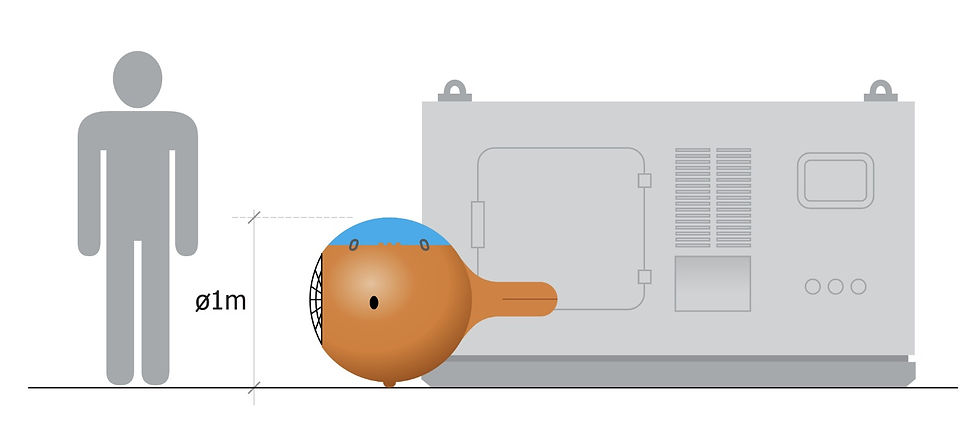
The turbine consists of a rugged outer shell with a brushless generator, ramp pump, and automatic positioning system. Once placed in a stream, the turbine anchors itself and detects the optimal position based on the tension in the anchor cables. This self-calibration process ensures it remains stable and efficient, even under changing water conditions.
Power is produced as the water activates the ram pump, which generates high-pressure pulses. These pulses drive the turbine blades, which rotate the generator shaft. The system produces 0.6–1.9 kWh of electricity, supporting essential loads like lights, refrigeration, and electronics for off-grid homes. Multiple units can be linked to power a small neighborhood.
The generator included a battery pack, an inverter, and automatic regulators, eliminating constant adjustment. It also withstands cold climates and does not freeze in winter, making it suitable for deployment across Canada’s diverse terrain.
Addressing Energy Poverty and Diesel Dependency in Remote Areas
Roughly 292 Canadian communities are not connected to the North American electrical grid. Most rely on diesel, which must be flown in, shipped, or hauled over winter roads—raising both costs and environmental risks. Spilled fuel contaminates land and water, and generator emissions affect human health. These systems are also unreliable, often leading to blackouts in critical conditions.
The HNP Mini Hydraulic Turbine addresses these challenges with a fully renewable, fuel-free solution. By harnessing nearby rivers or creeks, the system provides independent power generation without noise, emissions, or environmental disruption. Its plug-and-play nature allows anyone to install and operate it without technical expertise.
Replacing diesel generators with clean hydropower reduces energy costs significantly. Communities save fuel, logistics, maintenance, and generator repairs. With lower operational costs and fewer interruptions, local governments and households can redirect resources toward healthcare, education, and infrastructure development.
The solution supports communities' resilience while reducing dependence on external fuel providers. It also positions rural areas to attract new investments, as stable power availability is critical to supporting local businesses and long-term economic growth.
Scaling Micro-Hydropower for a Sustainable Future
The modular design of the HNP Mini Hydraulic Turbine allows it to scale flexibly with community demand. A single turbine can power one home. Connecting multiple turbines forms a decentralized “battery” of clean energy sources, offering a low-cost alternative to large utility projects.
This versatility is key to reaching underserved areas. Many Indigenous and rural communities are surrounded by water but lack the tools to convert it into power. By eliminating the need for heavy infrastructure or fuel deliveries, the turbine becomes an ideal fit for remote, seasonal, or mobile setups.
Environmental benefits are equally important. The turbine produces no carbon emissions, does not obstruct river flow, and avoids harm to aquatic life. Unlike hydro dams, it preserves the ecosystem while producing usable energy year-round. These characteristics make it eligible for clean energy grants and carbon-reduction incentives, further reducing the cost barrier to adoption.
Over time, the wider deployment of HNP turbines can contribute to national decarbonization goals, improve energy equity, and spark a new wave of decentralized renewable power systems led by local communities themselves.
Advancing Energy Access with Practical Off-Grid Hydropower
The HNP Mini Hydraulic Turbine offers a practical solution for off-grid power generation in a wide range of environments. With a compact design, easy setup, and no need for external fuel, it provides reliable electricity using only water energy. It can operate in rivers, creeks, or small rapids and functions in cold climates without the risk of freezing.
Its impact extends beyond technical performance. By reducing fuel dependency, lowering energy costs, and enabling local control, the system empowers communities to take charge of their energy future. Whether powering a single home or a small village, the HNP turbine delivers clean energy where it’s needed most. For rural and remote communities seeking energy resilience, this compact hydropower system represents an essential step toward long-term sustainability.

Comments