


Power From Running Water Can Be Small, Practical, And Built For Off-Grid Life
- HNP Power

- Feb 14
- 6 min read

A lot of Canadians think of hydropower as dams and massive stations. That image does not help a homeowner near a creek. It also does not help a remote community that runs on diesel and worries about the next fuel delivery.
For many off-grid places, electricity is not a convenience. It is heat control, lighting, refrigeration, communications, and safety. Yet many remote and northern communities still depend on diesel generation, which is expensive to ship and hard to maintain in extreme weather.
Water is different. If a community has a year-round flowing source, even a modest one, it can provide steady kinetic energy. The challenge is turning that flow into usable household power without building permanent infrastructure.
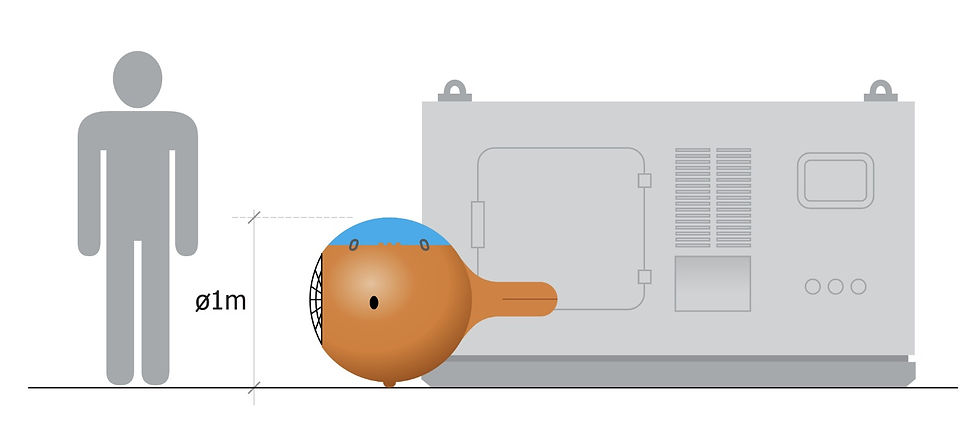
That is the gap we are working on at HNP Power. Our Mini Hydraulic Turbine is built to generate electricity from running water in low-velocity rivers and small creeks, without needing an external power source to run. In this article, we explain why diesel dependence is so hard to break, what small hydro can realistically do, and how our turbine is designed for real field conditions.
Diesel Power Works, Until It Becomes The Only Option
Diesel generators have one major advantage. They can run almost anywhere with fuel. That is why they became the default in many off-grid Canadian communities.
The tradeoffs are now hard to ignore. Fuel has to be transported long distances by plane, truck, or barge. That adds cost and spill risk. Diesel engines also bring noise, exhaust, and constant maintenance needs.
Canada has hundreds of remote communities that are not connected to the North American electricity grid. Natural Resources Canada’s remote community overview has long cited 292 remote communities with a combined population of about 194,000 using its criteria and census references. The Canada Energy Regulator also tracks how many remote Indigenous and northern communities still use diesel as their primary electricity source, while many pursue clean energy projects to reduce that dependence.
Diesel is also a planning problem. Weather can delay deliveries. Winter roads open for short windows. Barges have seasonal limits. When something breaks at the wrong time, the risk is not theoretical. It can mean outages in places where cold is not forgiving.
This is why “clean energy” in remote areas is not just about emissions. It is about local control. It is about keeping power on when supply chains get stressed.
Still, switching away from diesel is not simple. Large hydro needs dams and permitting. Solar needs storage for dark winters. Wind needs siting, maintenance, and seasonal variability planning. Most communities end up with a mix.
Small hydro can be part of that mix when water is available. It can run day and night. It can also fit within smaller footprints, if the device is designed to avoid major construction.
Small Hydro Has To Be Portable, Quiet, And Easy To Deploy
A mini hydropower device is only useful if it fits how people actually live and work off-grid. That means the system has to clear a few practical hurdles.
First, it needs to work in more than one type of water source. Not every community has a steep waterfall beside town. Many have wide rivers with slow flow. Others have small creeks with modest drop. A useful system must adapt.
Second, it needs a deployment method that does not demand specialized installation crews. Remote sites have limited access to trades. Getting heavy equipment in can cost more than the device itself.
Third, it needs to avoid permanent structures. Permanent works raise permitting complexity and can create community resistance. Many places want solutions that can be moved, removed, or redeployed.
Fourth, it needs to be quiet and low-impact. Hydropower gets political fast when people assume dams or fish disruption. A small unit that sits near a riverbank and uses anchors instead of concrete tells a very different story.
That is the design space we focus on. Our turbine is intended for low-velocity and small rivers, and it does not need an outside power source beyond the kinetic energy of flowing water. We also designed it so it does not require professional installation, because that requirement alone can kill adoption in remote areas.
Output matters too, but it should be discussed honestly. A device like this is not meant to replace a large grid connection. It is meant to cover core household needs when paired with sensible load planning. On our “How It Works” page, we describe a typical output range of roughly 0.6 to 1.9 kW under suitable conditions, and note that with practical distribution it can cover basics like lighting and refrigeration.
For some users, a single unit can support one home. For others, several units can run as a “battery” of devices for multiple homes or a small neighborhood, which can change cost and resilience compared to a single diesel generator setup.
How The Mini Hydraulic Turbine Uses Water Pressure, Not Just Speed
Many people assume you need fast rapids to generate power. That is not always true. What matters is energy capture, and in small hydro that often comes down to how you manage pressure and flow.
Our system is built around a combination of a hydraulic ram pump and a Kaplan radial-axial low-flow turbine. A hydraulic ram pump is a simple mechanism that can raise water without electricity. It uses inertia and gravity, and it relies on hydraulic shock, meaning rapid pressure changes in a pipeline.
In our setup, that pressure is used to drive the turbine so it can generate power even when the river itself is slow-moving. We describe this as a “water hammer” effect for developing pressure, paired with a Kaplan-style turbine designed for low-flow conditions.
This matters for Canada, because a lot of accessible water is not a steep drop. Many sites are wide and relatively calm. A system that depends only on high velocity would miss many realistic placements.
We also designed the turbine for different river types:
Wide, low-velocity rivers: installed close to the bank and attached to anchors or nearby land structures.
Small rivers or creeks: can use a pipe to direct flow to the inlet, with a noted minimum drop target around 1.5 meters for pressure in that configuration.
Multiple units together: installed as a series to serve more than one home.
Another design piece is positioning. Rivers shift. Flow changes across the width. In our “How It Works” materials, we describe an automatic positioning system that uses anchors, sensors, and tension readings to find an efficient working zone.
Cold weather is also part of the Canadian reality. We state that the device is built to operate in cold northern conditions and keep working across a range of tilt and positioning, which matters when ice, wind, and shifting banks are normal.
The goal is not a perfect laboratory installation. The goal is a device that keeps producing power when conditions are messy.
A Practical Path For Homes And Communities Starts With The Load Plan
Small hydro works best when people match the power to the need. That sounds obvious, but it is where many projects succeed or fail.
The first step is identifying the “must-run” loads. Lighting. A refrigerator or freezer. Device charging. Basic communications. In some cases, a circulation pump or small heating controls. These loads are steady and predictable, which pairs well with steady generation.
The second step is planning for peak loads. Kettles, dryers, large shop tools, and electric heaters can overwhelm a small system quickly. Many off-grid households already manage this with habits, timers, or backup generation. Small hydro fits into that same mindset.
The third step is thinking in seasons. Water sources change. Freeze-up changes access. The best setups treat hydro as part of a broader plan, alongside conservation, efficient appliances, and sometimes solar or backup diesel.
We built HNP Power for that reality. We are not promising that running water solves everything. We are building a tool that can reduce diesel runtime and diesel dependence where water access makes sense. That reduction can cut fuel costs, reduce noise, and lower spill exposure over time.
If you are evaluating a site, we recommend starting with simple questions:
What water source runs reliably through the year?
Is the location accessible for anchors and seasonal checks?
Are you powering one home, or planning a shared setup?
What are the must-run loads, and what can stay on a separate circuit?
When those answers are clear, the project becomes much more grounded.
If you want to explore whether a Mini Hydraulic Turbine fits your site, contact us through our pre-order and inquiry form. We will walk through your water source and your household or community load needs, then talk through a realistic deployment plan.


Comments